High-yield sustainable biomass for energy and feed
Napier Grass (Pennisetum purpureum), also known as Elephant Grass or Uganda Grass, is one of the most productive biomass crops in the world. Capable of producing 40-80 tons per hectare annually, it offers exceptional yield potential compared to traditional forestry.
Our specialized pellet mills transform this fast-growing renewable resource into dense, uniform pellets perfect for industrial boilers, power generation, and premium animal feed applications.
Perfect for: Energy farms, livestock operations, paper mills, and renewable energy projects seeking sustainable biomass sources.
Start Your Napier Grass Project
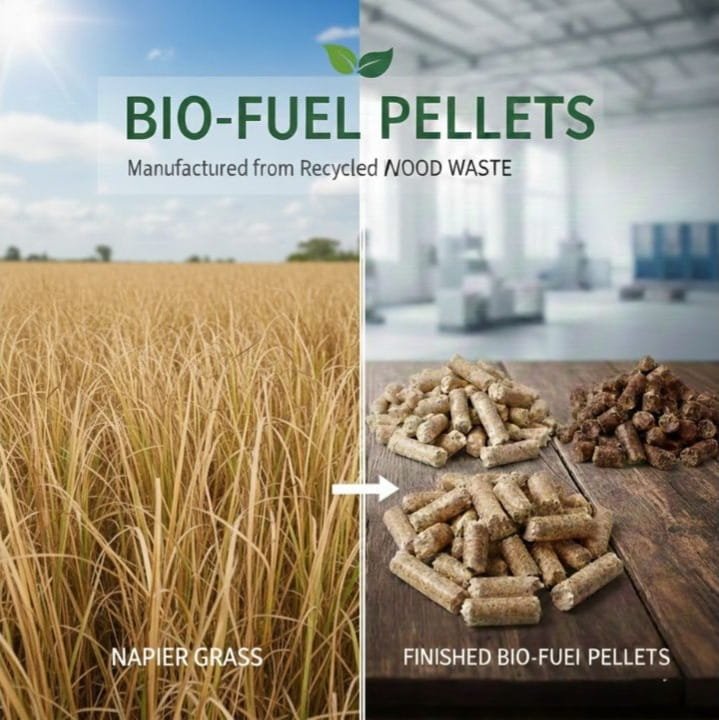
Superior biomass characteristics for energy and feed applications
40-80 tons/hectare/year - up to 10x more than traditional forestry
4,200-4,500 kcal/kg calorific value when pelletized
4-6 harvests per year in tropical climates
Perennial crop lasting 10-15 years without replanting
12-18% moisture after field drying - ideal for pelleting
Sequesters more CO2 than it releases when burned
Only 4-8% ash - cleaner burning than many alternatives
8-12% protein content for animal feed applications
Versatile biomass solution for multiple industries
High calorific value and consistent quality make Napier pellets ideal for utility-scale power plants.
High fiber and protein content provides excellent nutritional value for ruminants.
Serves as renewable feedstock for various industrial applications.
Clean-burning pellets suitable for home heating systems.
Emerging applications in green building materials.
Source of valuable biochemicals and platform chemicals.
Engineered solutions for optimal pelleting results
Freshly harvested Napier grass contains 70-80% moisture, requiring significant drying before pelleting.
Field drying to 30-40% moisture, followed by our high-efficiency rotary dryers bringing it to optimal 12-15% for pelleting.
Long, tough fibers can be difficult to feed uniformly into pellet mills without proper preparation.
Multi-stage cutting and grinding system reducing fibers to 3-5mm optimal particle size for consistent pelleting.
Peak growth periods require processing capacity that may be underutilized in off-seasons.
Pelleting increases density 8-10x, enabling cost-effective storage of harvest surpluses for year-round processing.
Nutrient content and fiber quality vary with growth stage and harvesting frequency.
Advanced control systems maintain consistent pellet quality despite raw material variations through precise conditioning.
Economic, environmental, and operational advantages
High yield per hectare (40-80 tons) combined with 4-6 harvests annually provides superior return on investment compared to forestry.
Napier grass captures 40-50 tons CO2 per hectare annually - among the highest of all biomass crops for carbon credit potential.
Thrives on land unsuitable for food crops, avoiding competition with agricultural production while improving soil quality.
10x density increase through pelleting dramatically reduces transportation costs - ship 10 tons of energy in the space of 1 ton loose grass.
Local renewable fuel source reduces dependence on fossil fuels and imported energy, enhancing national energy security.
First harvest just 120-150 days after planting, with subsequent harvests every 60-90 days in favorable climates.
Deep root system (up to 4 meters) accesses groundwater efficiently, requiring minimal irrigation even in semi-arid regions.
Dense root mat prevents erosion while perennial nature means no annual tillage, preserving soil structure and carbon content.
Same crop serves both energy and premium animal feed markets, providing marketing flexibility based on commodity prices.
Comparative analysis of biomass characteristics
| Characteristic | Napier Grass | Wood Chips | Rice Straw |
|---|---|---|---|
| Annual Yield (tons/ha) | 40-80 | 4-8 | 5-10 |
| Calorific Value (kcal/kg) | 4,200-4,500 | 4,500-4,800 | 3,500-3,800 |
| Ash Content (%) | 4-8% | 0.5-2% | 15-20% |
| Harvests per Year | 4-6 | 0.1-0.2 | 1-2 |
| Time to First Harvest | 4-5 months | 10-20 years | 3-4 months |
| Crop Lifespan | 10-15 years | Single harvest | Annual replanting |
| Protein Content (%) | 8-12% | 0-2% | 3-5% |
| Land Competition | Marginal land suitable | Forest/agricultural land | Agricultural land only |
From small-scale operations to industrial facilities - we design complete turnkey solutions
Request Project Consultation